Can you remember the the Wells House School building ? Here’s a tour …
This document is an extraordinarily detailed account of the internal layout of The Wells House towards the end of Alan Darvall’s (Beak’s) 35 years as Headmaster (1933-1968).
As such, it forms a fascinating record of the place at which we were educated as boarders. It will be placed with the rest of school’s archives at The Hive in Worcester.
The author, who attended the school from 1962 to 1967, wrote this in 2026. He is happy for your committee to share it with you, although he wishes to remain anonymous.
One member of the committee has made some minor changes and additions to it, with the agreement of the author, but essentially this document was written by one person.
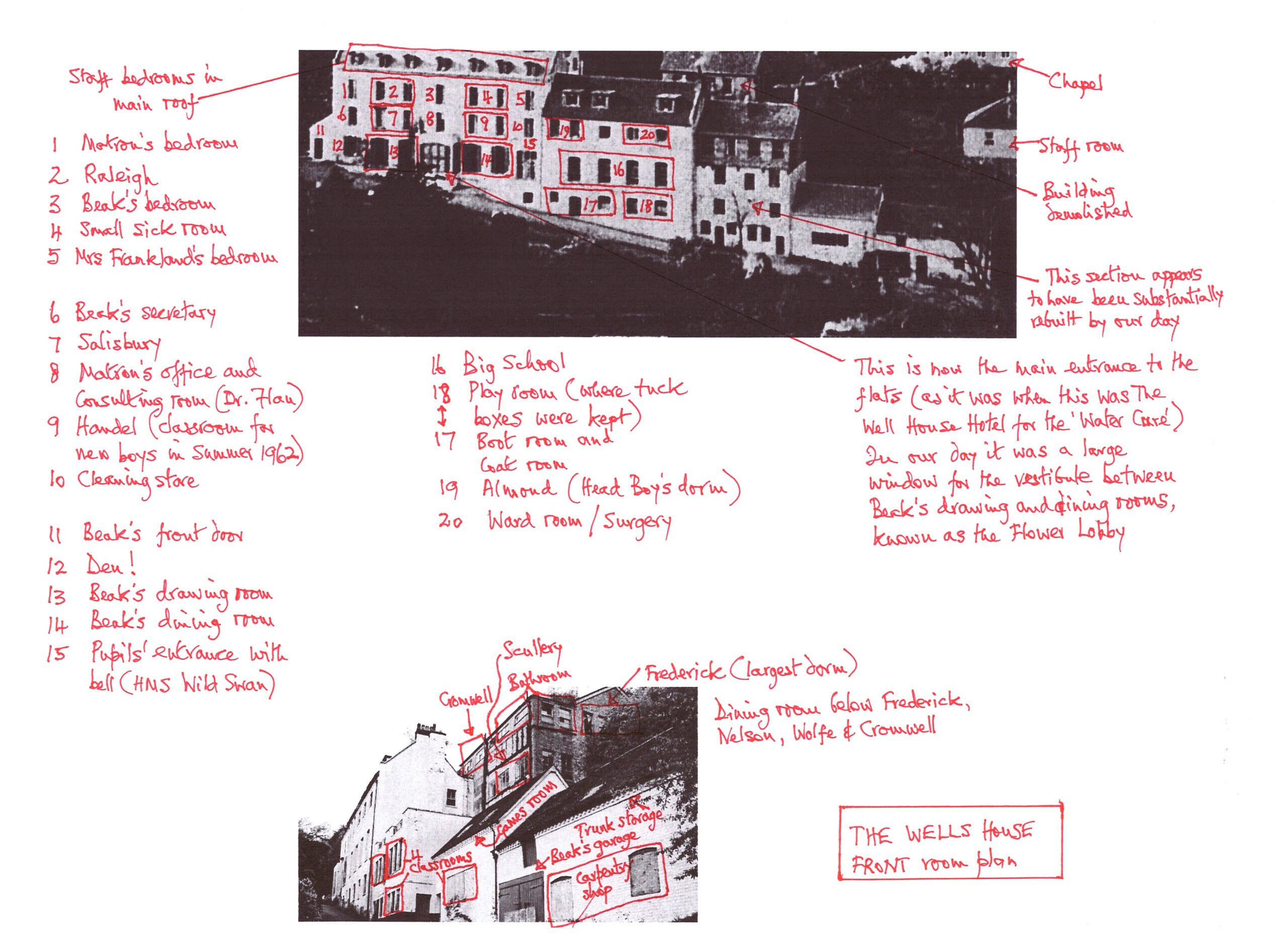
Download Article here – Can you remember the Wells House School building. Here_s a tour
A TOUR OF THE INTERIOR OF THE MAIN SCHOOL BUILDING
Ground Floor:
Going up the outside stairs and in through the pupils’ entrance, one found oneself in the Bell Lobby. The bell of HMS Wild Swan was on one’s right by the window, in which there was a small hole – allegedly from a German bullet, but more probably a flaw in the glass.
In relation to the pupils’ entrance, it is worth noting that, each morning, after cold baths, in the road outside by the school flag, known as the quarterdeck, a rollcall and inspection took place. Boys had to line up in alphabetical order and, when the Head Boy called out your name, you had to respond by saying ‘ad sum’. Beak would stand at the top of the steps watching proceedings. Boys then went for the morning run – walking up to Rock House then running back – before going into the dining-room for breakfast.
Turning left from the main entrance, one saw the official School Clock on the wall at the top of the stairs. On the right was the door into Big School, and beside it was the notice board on which Fortnightly Orders were posted on Sunday morning.
Going up the wooden stairs, one entered the wood-panelled and red tiled main corridor, which was lined with photographs of former Head Boys. Turning left there, one passed the telephone room under the main staircase, the dark room and the stock room (where Mr Harris reluctantly handed out pink blotting paper, dip pens, etc.). There was also a kitchenette along there, from which Mrs Frankland served Beak’s tea (and probably alcohol for guests as well!).
On the left one came to the Flower Lobby, on the exterior wall of which there was a chest, on top of which there was usually a trough containing hydrangeas or other flowering plants. On the left was the door into Beak’s dining-room, where we met at the New Boys’ Tea Party. On the other side of the Flower Lobby was Beak’s drawing-room. We were allowed to practise on his baby-grand there during Rest after lunch. We could also play quietly there when he wasn’t using it, and sometimes he would read stories to a group whom he had invited. His deep arm chair was to the left of the fire, and there was a sofa and another deep armchair. We were also allowed to listen to Beak’s valve radio – two members of the Committee thus remember hearing news of Kennedy’s assassination. Mrs Frankland would ask us to leave Beak’s drawing-room when Beak was due to take his tea in there.
On the other side of the main corridor from the Flower Lobby was Beak’s staircase, which we were not allowed to use.
Carrying on down the main corridor, Beak’s Den was on the left, and beyond that, also on the left was his front door. There was a large window at the end of the main corridor, and the door into the Library was near it on the right, almost opposite the door to the Den.
Apart from the Chapel, the Library was my favourite place in the school. I spent many, many happy hours there. There was a long table to the left of the door, flanked by benches and covered with some sort of coarse blue cloth. In front of the French windows on to the car park there was a desk for the Librarians to use when they recorded the books that pupils borrowed during rest after lunch. At the opposite end of the Library there were some chairs, and there was a table from which Mrs Frankland dispensed coffee to staff after lunch. On the left of the door were some hooks where keys with very large metal tags were hung. Opposite them were the wooden drawers which contained the Library index cards.
The Chapel was a pre-fab building, similar to those sent to the British Empire’s colonies. The external corrugated material was in contrast to the internal panelling, with plaques on the wall commemorating past pupils who had lost their lives in various wars. The Chapel had a single manual seven stop Nicholson organ with pedalboard. I loved the smell of the fruit at the Harvest Thanksgiving, with the giant loaf in the form of a sheaf of corn and a little mouse. The School Prayer was as follows:
‘O God, by whose manifold grace all things work together for good to them that love Thee; establish, we pray Thee, the thing which Thou hast wrought in us, and make this School as a field which the Lord hath blessed, that whatsoever things are true, pure, lovely and of good report, may here for ever flourish and abound. Preserve in it an unblemished name: enlarge it with a wider usefulness, and exalt it in the love and in the reverence of all its members, as an instrument of Thy glory, through Jesus Christ our Lord. Amen’.
Going back down the main corridor, once one had passed the Bell Lobby on the right one came to the main stairs on the left (with blocks on the bannisters to prevent one from sliding down them.) Under these stairs was a narrower staircase that led down to the Boot Room.
Beyond these, also on the left, was the door into the kitchen area. We were not normally allowed to go through there, but immediately beyond it there was a staff sitting-room – with a television – which served as a Green Room in which the actors were made up, and where they waited for the turn of their cast to present one of the One Act Plays at the end of the Christmas Term. The TV was mainly for kitchen staff, but it was moved into Big School for State occasions – in our time, these included the opening of Coventry Cathedral and Churchill’s State funeral. Beak and the Head Boy went up to London to represent the school at Churchill’s lying-in-state.
On the left, further down the main corridor, was the large chest that served as the Pound. We had to pay a 1d fine for anything we took out of it. Opposite to the right there were opaque windows into Big School, and below these were the dreaded TW (Returned Work) and PD (Penal Drill) books. Along this wall were the open cubby hole shelves where we kept our hymn books (red) and psalters (blue). If you got four penal drills in a week, you were given a PDD (penal drill detention); if you got two PDDs in a row, you were beaten.
As well as the TW and PD books, there was a third book for lost property. Beak’s secretary would draw a line in the TW book on Friday and, if you hadn’t got your TW signed off by Monday lunchtime, you were beaten. The system was really unfairly loaded against the pupil because, after the line was drawn on the Friday, the first occasion on which he would have had any extended time to do the work would be on the Saturday evening; and even if he finished it, he wouldn’t have been able to show it to the master then. On the Sunday there would have been no opportunity to do the work until whatever time was left between returning from the afternoon walk and supper; and once again, the master concerned would not have been available to approve it. At Bun Break on the Monday morning there was therefore usually a frantic scrum around the door to the Common Room, with pupils imploring the masters concerned to come out to sign off their work, or to test them on their history dates or French or Latin verbs. If the master wasn’t there, or if he couldn’t be bothered to come out, the poor pupil was for it. And the situation was even worse if the TW was for Beak himself because he wouldn’t be in the Common Room, and one didn’t just call into The Den uninvited (I sometimes wanted to do so in my latter years because I thought that he might be lonely: but I didn’t dare).
At the end of the main corridor were some steps to another small space. On the right of this there was a door into Big School, and there were some lockers for pupils (in 5A and 5B) who used Big School as their classroom, and who therefore did not have desks in which they could keep things. The backs of the benches in big school could be turned over to serve as desks, but they had no storage space. On the wall on the left was a board with the holes for corks with pupils’ names on, which indicated in which teams they were to play. A pin was stuck in the cork of the boys who were to be the captains of their respective teams. Beside this board was the Pack Points chart that showed the relative positions of the four Packs (Lions-red, Bears-blue, Tigers-yellow and Wolves- green. These were also the colours of the Airtex short-sleeved shirts we wore in the Summer.)
On the left of this space was the door into the Downers where there were loos, and where – in the 25 minutes of precious freedom before lunch – we had to try get the ink off our hands by scrubbing them raw with pumice stones, and washing them with that horrid, hard, pink Premiere Products soap. It was in this 25-minute period that daily penal drills took place for pupils whose names had been read out from the PD book by Beak at morning Double. The PD punishment was to do 20 minutes of non-stop exercise under the watchful eye of Serge or, sometimes, Beak.
To the right of the door into the Downers was the entrance to a short landing illuminated by a skylight, on the right of which was the door into a classroom (2A?), where Miss Felicity Stevens taught in my day. This classroom was a second-hand type of portacabin placed on a flat roof, which is why it does not appear in the photograph. At some point, it was so rotten that it had to be removed! Miss Stevens was an outstanding and kind teacher (Oxford graduate). She introduced me to C S Lewis’s The Lion, the Witch and the Wardrobe!
Miss Stevens had a 1935 Morris 8 convertible, which she kept by Rock House. By the time it had rolled down Holywell Road to the Wells Road, it would have started! When Miss Stevens’ Morris 8 failed its MOT, she got an old Ford Prefect. Beak had a Mark 8 Jaguar then a Humber Super Snipe. Mr Patterson and Miss Bates had Ford Populars and Mr Hall, Mr Mitchell and Mr Moss had Bedford dormobiles (which were much in evidence at school camps at Rhayader and Symonds Yat). Miss Jewel had a Ford Anglia estate. Mr Harris had a Vauxhall Victor estate. Miss Oldlands had an Austin Healey Sprite followed by a Triumph Spitfire. Mr Ridings had a Singer Gazelle, Mr Cubbon a Humber Hawk and Mr Wingfield-Digby had a VW Beetle. Mr Long had an Austin A35 van and Chips had a three-wheel Bond. Miss Bateman, the Cook, had a red Mini.
On the left of Miss Stevens’ classroom, there were stairs that lead downwards. At the head of the stairs there were some more loos which – though equally lacking in privacy – were rather less unpleasant than the Downers.
Lower Ground Floor:
Opposite the foot of the stairs was a door into a classroom (2B?) which I think we used in our second term. After our first term, I think that the room that we had used as our classroom reverted to being a dormitory (Handel), and the classroom we used in our second term was used by Form 1.
On the left of the foot of the stairs was the door into another classroom (2B?), and on the far side of that classroom were some steps that led into a sort of loft. There was a table there where one could assemble plastic models or balsa-wood boats and gliders.
On the right of the foot of the stairs was the door into the Play Box Room – the warmest place in the school. At first this served as the Art Room until the Centenary Building was opened; but it was mainly an area where one could play board games, and play with the contents of one’s Play Box: after Beak’s time it became the Library.
On the left on the far side of the Play Box Room was the door into the Coatroom, where our Macintoshes and overcoats hung, and beyond that was the Boot Room, lined with cubby holes for our shoes. (Gym shoes, Cambridge house shoes, one pair of lace-up walking shoes, and rugger or cricket boots – one’s other pair of lace-ups were in use in the day time.) On the top of these cubby holes were our Wellingtons.
To the left of the Boot Room was an external door: on the far side was the entrance to the shoe-cleaning area, with its two parallel, raised metal rails; and in the right-hand corner of the Boot Room the stairs led up to the main corridor on the ground floor.
Going outside, and turning left one went down the hill, past the boiler room, and then turned left again to face the house, On the left was the door into a classroom (3A?), and straight ahead was another classroom. I think it was when I was in 3A that I was taught by Mr Horton – young, very nice, recently married and another excellent teacher – who I recall giving us Latin proses to translate into English. He had composed these himself, and we often featured in them.
To the right were Beak’s garage and the Carpentry Shop, above which was a storeroom, accessed from the path behind the building (which led up to the back of the kitchen and then to the staff / music building. It was here that our trunks were stored during term-time.
At the end of term, the trunks were brought up to our dormitories for the matrons to pack – always a sure sign that the holidays had nearly come at last. The boys who were going to be returning home by train had to write labels for them.
The last afternoon of term was often taken up with something like picking up sticks or rubbish from the grass, just to keep us busy. Then we had to collect what was left of our pocket-money from The Den. The usual amount was £1 for the term, and I always had most of it left.
After supper, we had the end of term film, which was on big reels that had to be changed over half-way through. The Battle of the River Plate was the film at the end of our first term, which was very exciting. A term or two later, we had a film about the North West Frontier, starring Kenneth Moore – perfect for training chaps to run the fast-vanishing British Empire! Then there was mark-reading, the announcement of which form we were to be in the next term, who was the Intellectual Head of the School, and which Pack had won the Pack Competition. Then there was Chapel with Psalm CL, Praise My Soul the King of Heaven, the General Thanksgiving and Lord, Dismiss us with Thy Blessing. This last was always sung with considerably more gusto than Lord, Behold Us with Thy Blessing on the first morning of term!
And on the final morning I remember waking up terribly early in an agony of suppressed excitement, longing for the rising bell.
First Floor:
Going up the main stairs from the ground floor to the first floor, one had to pass the matrons who inspected one’s hands before lunch. At the top of the stairs one entered a room lit by a large skylight, and around the walls there were notice boards on which interesting, illustrated articles on all sorts of subjects were displayed. These were changed weekly – I rather think by Miss Jewell – so the school must have had a large store of them.
As you went up the stairs, on your right, were the scholarship honours boards. If a boy won a scholarship to his public school, the whole school was given a half-day holiday. We were given a packed lunch (usually including a pork pie, or a Scotch egg, some Walkers’ crisps and an apple) and could go out anywhere we liked (except into town). We had such freedom on the Hills, and no-one ever bothered us. Most children nowadays never experience anything like this.
To the left at the head of the stairs was the door into the Museum Room – which was used as an overflow Dining Room in our first term. In glass cases on the walls was a motley collection of artefacts that had been presented by Old Boys who had gone out to govern the Empire. On the tables here we were served an orange and two ginger biscuits after Chapel on Sunday; and there was a piano. We also used to play in this room. On the far side of the Museum Room was an external door to a sort of decking which overlooked a door into the kitchen area. On the right were French doors into the dining-room; on the left were steps that led up to the pathway to the Common Room, the Chapel and out on to the Hills.
Returning to the room at the top of the main stairs, there was a large table in the middle, and at the far end to the left was the door into the Dining Room. To the left of this was the notice board on which the Leading Article from the day’s Times was displayed for our edification. (I wonder how many 11 and 12 year-olds nowadays regularly read the Times Leaders?)
In the dining-room, on the left as one went in, was the dumb waiter serving lift on which food was brought up from the kitchen. Towards the middle of the wall on the right of the door was a hatch that opened into the scullery where the plates were washed. At the far end of the dining-room, there was a door into the scullery and another one from the room at the top of the stairs. The dining-room wall was lined with Head Boy Boards. Head Table (Benedicat Benedicatur) ran crossways at the far end of the Dining Room and the other tables ran length ways down it. The curtains were flowery on a red background.
At the far end of the room at the top of the main stairs were the stairs that led to the dormitories in the New Wing over the Dining Room. Under these stairs was a cupboard where dressing-up kit was stored. I can only remember its contents ever being used before the Fancy Dress Party at the end of the Spring term. (On our first such party, we went as the Oxford Boat crew – in horrid, itchy woollen dark blue games clothes – and someone was cross because the oars we carried had had to be cut down for us to manage.
On the subject of parties, who could forget the Halloween parties, with apples hanging from strings across Big School. Boys always seemed to end up covered in treacle, which was probably the idea! Also, we had to bob for the apples which were floating in big tubs filled with water. I always got wet, but never caught an apple. The golden syrup was on a suet pudding that was hanging on a string. We had sometimes had that pudding at lunch, and I knew that I didn’t much care for it, so I didn’t even try to get sticky. There was also Kim’s Game, in which we were all blindfolded and had to pass numerous objects from hand to hand – including some raw sausages, which always caused squeals of disgust – and then write down all those that we had identified and could remember. The Hallowe’en party precluded any celebration of 5th November. Personally, I would have preferred a bonfire and fireworks!
I remember our form having to perform A Magnet Hung in a Hardware Shop from Patience at the Concert towards the end of our first term. The concert ended – as events always did in those days – with the National Anthem. I think that that was the first time I had sung it.
Also under these stairs was the table on which our mid-morning Bun Break snack and milk was served form Monday to Saturday; and where a hot drink (sometimes cocoa and sometimes Ribena) was served to older boys after Prep.
Going up the stairs into the New Wing, one found four dormitories for the 7:45ers. At the back of the house, from left to right, these were Nelson, Wolfe and Frederick. Turning to face the front of the house, on the left was the bathroom (with showers), and to the right, near the stairs was the dormitory Cromwell.
The 6.20 dorms were Raleigh, Churchill, Gladstone and Salisbury. The 7.00er dorms included Wellington and Clive. I remember lying in bed in Wellington listening to the strains of Singing Prep with dear old Woodie wafting up from Big School on Wednesdays (I think it was – when they sang folk songs like Rule, Britannia!, and The Ash Grove and Campdown Races, and Uncle Tom Cobley, and Tom Bowling, and Waltzing Matilda, and Trelawney and Wi’ a Hundred Pipers, an’ a’, an’ a’) and Saturdays (when they prepared the Canticle, psalms and hymns for Sunday and the following week.)
The language of some of the hymns would now be considered too advanced for children. But we were used to the Authorised Version of the Bible and the Book of Common Prayer and Shakespeare and classic poetry – remember Beak’s Poetry Readings – Masefield’s Cargoes was always requested – so we just lapped up sonorous phrases like “Consubstantial, co-eternal, while unending ages run”.
Because Shakespeare’s language is so isolated now that people are no longer familiar with the Authorised Version of the Bible and the Book of Common Prayer, his plays are often considered too difficult for young children. But I first went to see the Dream (with Charles Laughton as Bottom) at Stratford when I was five, and Romeo and Juliet on a revolving stage there when I was six – and I loved it. We were shown Olivier’s film of Richard III at TWH, and Beak took us to see David Warner’s Hamlet in 1966; and to see the Shrew there the following year. Wonderful!
Towards the middle of the right-hand wall of the room at the top of the main stairs was an opening and some steps that led to the main corridor that ran along the first floor. At the end on the left was the door where our games kit was stored, hanging in string bags with our swimming towels (but no trunks!). On the other side of the main corridor (ie at the front of the house), and slightly to the left was the Wardroom, where our clean clothes and Red Coats were stored in large drawers, and where first aid and medicines – and malt extract or Haliborange tablets – were administered. There was a chair in the far left-hand corner where one sat to have one’s temperature taken – and where Head Matron told me to “plod on” when I had what turned out to be pneumonia. On the wall opposite the door into the wardroom was the notice board on which were put at the beginning of each term the list of the boys who had been assigned to each dormitory. The list of boys who had received parcels was also put up there every morning. One had to wait until the pre-lunch break to be able to open one’s parcel in the presence of a matron, to ensure that it did not contain any contraband sweets or comics. (Penknives and sheath-knives were, however, permitted! I carried a pair of scissors in a sheath on my belt at one stage, and I remember using these to stab a boy who was bullying me in the leg. This proved effective: he didn’t do it again.)
Between the wardroom door and this notice board there was a staircase that led up to what – before our day – had once been dormitories, but were now staff bedrooms, including Mr Harriss’s. I don’t know where their bathroom was. There was a half-landing near the bottom where there was a window with a wonderful view. I often liked to sit there whilst waiting before lunch.
Now, turning with the Hills to one’s right to face the full length of the main corridor, on the left there was the door into Almond, the Head Boy’s dormitory. This was the only dormitory for 8:15ers in the main building. On one of the windows here there was the Davy automatic fire-escape, a contraption by means of which one could be lowered to safety in the event of a conflagration. Fire practice using this were very exciting. It was rather like abseiling.
Beyond Almond, also on the left, were the narrow service stairs that led to the second and third floors. Across the corridor ran a short flight of stairs that led up to a somewhat different level. On the left was first the cleaners’ store and then the room we used as a classroom in our first term, and that subsequently reverted to being a dormitory (Handel). Then came Head Matron’s office, where we had our medicals with Dr Flan (the first was painful and traumatic) – and where, on our first night, Head Matron tried to cheer me up by assuring me that it would only be another six or seven weeks – an eternity to a 7 year old – before I would see my parents again. I did not find this very consoling.
On the right was the big bathroom – which was about as cosy as a mortuary – and where one had one’s cold swill in the morning and either a stand-up bath for 3 or 4, or a sit-down bath for 2, each evening. The big bathroom had six baths; to its left was the small bathroom with two baths. Then one came to Beak’s stairs.
Further along on the left was the dormitory Salisbury, and beyond that was Mis Jewell’s office, where we played Happy Families – most inappropriate, under the circumstances – just after our parents had left us that dreadful first afternoon. By Miss Jewel’s office, there was another set of service stairs to the second and third floors, but these were only used by staff.
On the right, beyond Beak’s stairs, there was back door with a sort of bridge that led to the paths on to the Hills. Beside it was single loo. There was sometimes such a lagoon of urine around this that one had to balance very precariously on the wainscoting to avoid getting one’s slippers soaked. Yet further along the main corridor was the small dormitory Churchill, and then the larger Gladstone.
Second Floor:
Going up now to the second floor, and turning with the Hills to one’s right to face the main corridor, on the left was Mrs Frankland’s bedroom and then the Small Sickroom, with Beak’s bathroom opposite on the right.
Then, on the left, came Beak’s bedroom, which was opposite his stairs. Did Head Matron, and Beak’s guests all have to share his bathroom with him? I hope that there were some separate facilities for them, but I don’t know where, exactly!
Raleigh was on the left, with Head Matron’s bedroom beyond it at the end. I think that there was a guest bedroom (above Churchill) on the right. I think that I saw Mr Livie-Noble, the psychologist, in there for an IQ test in October 1963. I still have his report, and I see that I scored 149, which, he said, was “well above the average among candidates for grammar schools and public schools”; so that was reassuring. Opposite Matron’s bedroom (and above Gladstone) was the large sick room.
Third floor:
Beak’s staircase went on up to the third floor, most of which was occupied by staff in rooms facing east (with dormer windows). There were also a couple of small dormitories up there facing the hills. Half way up the last section was the door that led to the Uppers, which contained six loos for use of the junior boys. The word “had” needs to be stressed here, because we were required to use them after breakfast each morning, and to report on our progress to a matron who was waiting outside with a record book. If we were unable to report success, she would send us back to try again! Failing that, there was an obligatory visit to Matron for some Milk of Magnesia! There were no hand-basins there, so we couldn’t wash our hands. Above that door there was an enormous cold-water storage tank, which must have supplied much of the school and always seemed to be gurgling away.
OTHER SCHOOL BUILDINGS :
Centenary Building:
The gym was entered via a vestibule where one changed into gym shoes. On the hill side of the gym were the wall bars, and part of the way down on the right were suspended a series of ropes that could be pulled out for climbing. I never succeeded in climbing any of these. Games in the gym when it was wet were generally fun: but I absolutely detested the few boxing classes I had to endure.
At the far end of the gym was the stage, which was closed off by sliding doors. Beneath the stage there were doors that could be opened to expose targets for shooting with air-rifles and 0.22s. I never hit anything that I aimed at, so I probably left my mark on the inside of those doors.
Beyond the stage was the Sixth Form room, which was very pleasant.
There were loos beneath the ramp that led to the first floor. The corridor at the top of this was open to the elements on its right side. On the left were the classrooms: a double one for Art (with nice warm radiators); 3B; 4B; 4A; and then another double one for Science.
Rock House and May Place:
The other 8:15ers slept in these houses. Although I spent two terms in both of them, I can’t remember much about Rock House and May Place, except that the dormitories were small; and I think that those at May Place may have had bunks. There was a room there on the ground floor where there was a table-tennis table – which we ran around until only two players were left – and a gramophone. I remember playing some of my early Beatles 45 records there. I don’t think that Rock House had any recreational facilities.
Mr and Mrs Hall and Mr and Mrs Cubbon lived in May Place with their families; Mr and Mrs Ridings and a single master lived in Rock House. May Place was considered the preferable boarding house of the two for a number of reasons; Rock House, which was built against rock as its name implies, was damp and got little sun. Mr Wood lived in The Manse.
Sporting Facilities at The Wells House School :
Great emphasis was placed on sport and physical training. Mention has been made already of morning runs, ropes in the (well-equipped) gym, free access to the middle section of the Malvern Hills and penal drills. There were also exercises (P.T.) in the car park after first lesson, long walks, work on ‘the digging’ and runs during wet weather.
As pupils knew only too well, a disadvantage of a school so high up on the Malvern Hills was the distance to the playing fields. Games four days a week at the playing fields (by Malvern Golf Club) were an important part of life. The school had a particular reputation at rugby, but cricket was played in the summer and the annual Sports Day was a major event.
Finally, there was the outdoor swimming pool, surrounded by corrugated panels as boys didn’t wear swimming trunks (even on Sports Days when families were present)! The open-air pool had no filtration system, but was refilled a couple of times per term directly from the water main. Beak taught boys to swim using a piece of hosepipe attached to a pole.
Article by Anonymous, April 2026
Edited with additional memories by Association Committee members, Galen Bartholomew and David Barnett